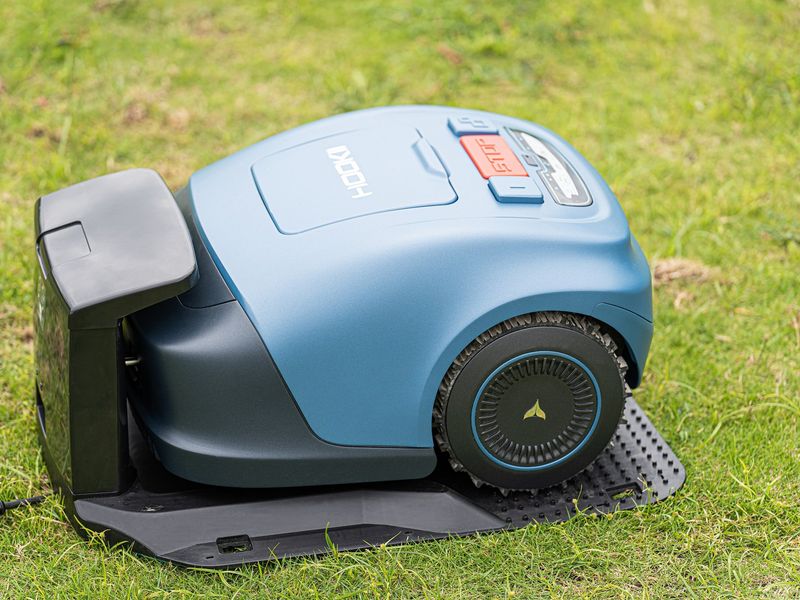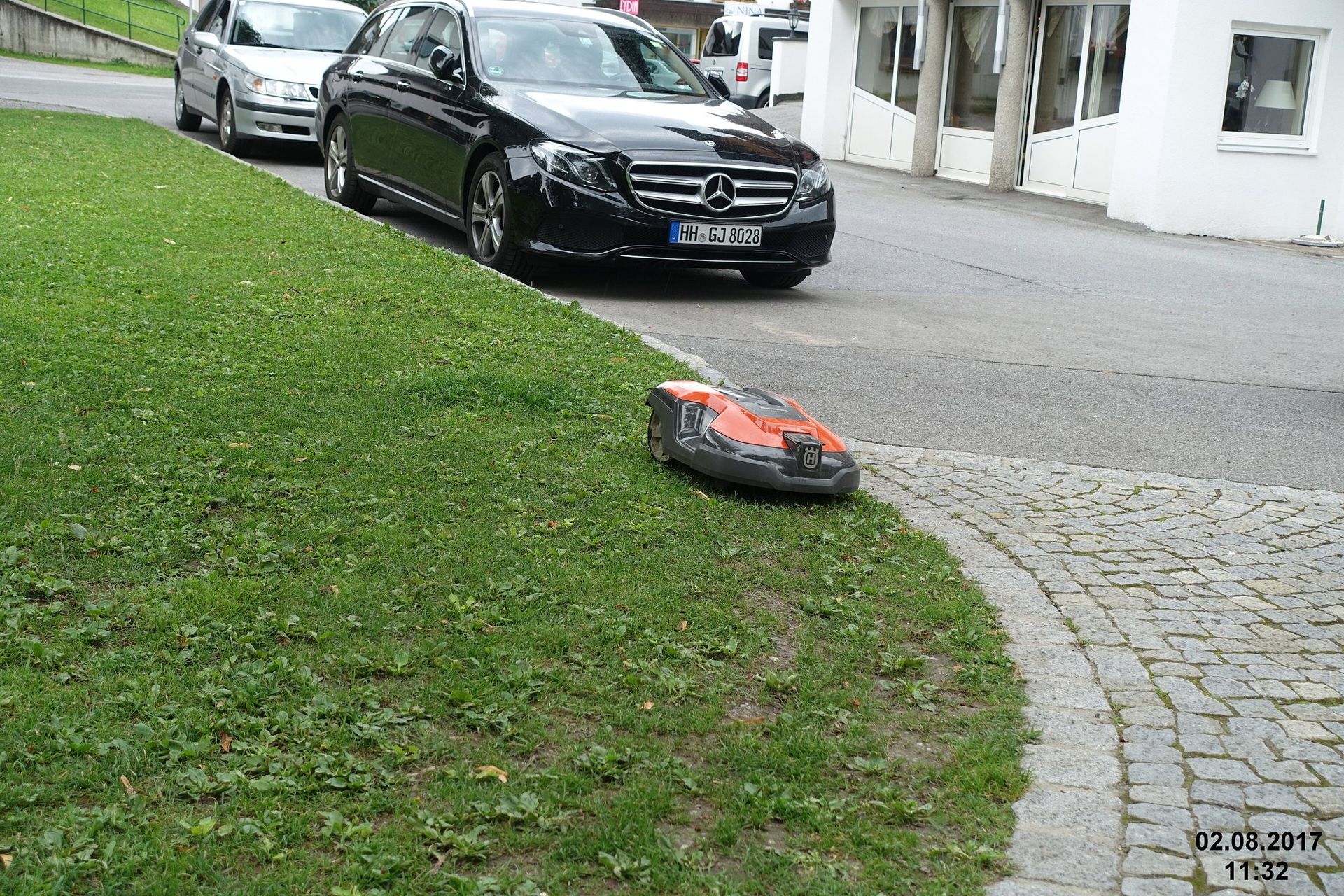
We have been mowing for 32 years — with a scythe, a push mower, petrol and battery machines and now robots — and the most common robot-mower mistake we see is simple: people buy the mower first and look at the garden second. A robot that is perfect on a flat suburban rectangle can be miserable on a sloping, tree-lined plot with three separate lawns.
So start with the garden. Answer the seven questions below, and the shortlist almost writes itself. Every model mentioned is in our robot mower catalog, where you can filter by area, slope, drive and navigation.
1. How big is your lawn — really?
Measure only the grass, not the plot. The easiest way is the area tool in Google Maps or Google Earth: right-click, Measure distance, and click around the lawn edge. Subtract beds, patios and paths.
Then add a buffer of 30–50 %. The area on the box is a maximum under ideal conditions — flat, simple shape, short grass, mowing almost every day. Slopes, narrow passages, many obstacles and fast spring growth all reduce what a mower can handle. A 900 m² lawn with a slope and trees calls for a mower rated for 1,200–1,500 m², not 1,000 m².
- Up to 500 m²: compact mowers, often vision-only or simple RTK — e.g. eufy E15, Bosch VISIMOW for tiny yards, Mammotion YUKA mini 2.
- 500–1,500 m²: the biggest choice — Navimow i206 AWD, ECOVACS GOAT O1000 RTK, MOVA LiDAX Ultra 1000, WORX Landroid Vision.
- 1,500–5,000 m²: wider decks (30–40 cm) and bigger batteries — Mammotion LUBA 3 AWD 5000, Dreame A3 AWD Pro 5000, Navimow X390.
- Above 5,000 m²: large-area specialists such as Lymow One Plus, Sunseeker X7 Gen 2 or Ambrogio 4.36 Elite RTK. See best robot mowers for large lawns.
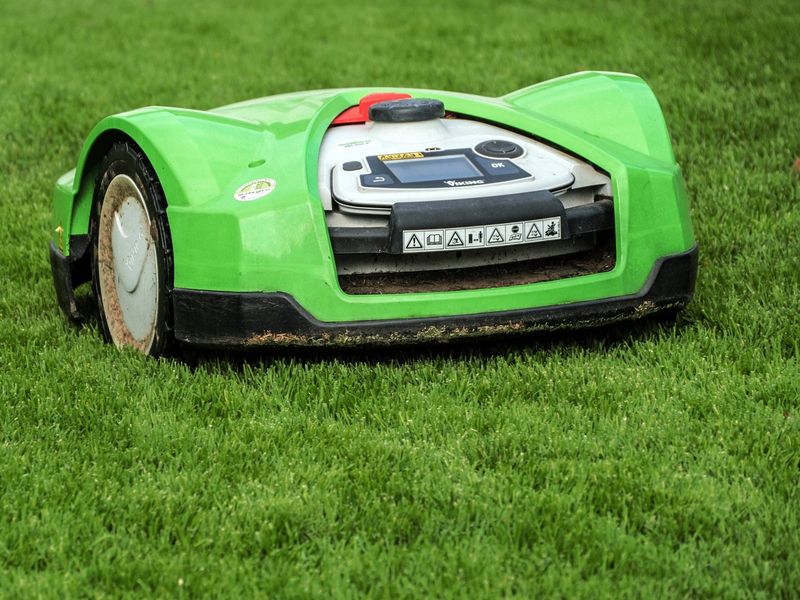
Lawn size → what to look for
| < 500 m² | 500–1,500 m² | 1,500–5,000 m² | > 5,000 m² | |
|---|---|---|---|---|
| Rated area to buy | 600–800 m² | 1,000–2,000 m² | 3,000–6,000 m² | 10,000 m²+ |
| Cutting width | 18–22 cm | 20–24 cm | 30–40 cm | 35–50 cm |
| Typical navigation | Vision / wire | RTK+vision / LiDAR | RTK+vision / LiDAR | RTK, network RTK |
| Typical price | $400–1,300 | $900–2,300 | $2,000–3,500 | $3,000+ |
2. How steep is it?
Slope is the spec manufacturers stretch the most, so check it carefully. It is given in percent, not degrees: 100 % = 45°, 50 % ≈ 27°, 35 % ≈ 19°. Measure the steepest part of the lawn with a phone inclinometer app on a long, straight board.
- Up to 35 %: almost any mower will do.
- 35–50 %: choose a model rated for at least 10 percentage points more than your slope, with good tyres.
- Above 50 %: look at AWD (all-wheel drive) — Mammotion LUBA 3 AWD, Dreame A3 AWD, MOVA LiDAX Ultra 3000 AWD, Roborock RockMow X1 and WORX 4WD are rated at 80–84 %. Tracked machines like Lymow go further still. Our list of AWD robot mowers and the best mowers for slopes compare them.
Remember that wet grass cuts traction dramatically: a mower that climbs 45 % in the dry may slide on 35 % after rain.
3. What does the sky look like? (Trees, walls, shade)
This decides the navigation system — the topic of our detailed explainer RTK, LiDAR or vision: how robot mowers find their way.
- Open lawn, clear sky: RTK or RTK + vision is ideal and gives neat straight lines.
- Mixed garden, some trees: RTK + vision, or LiDAR.
- Many tall trees, walls, narrow passages between buildings: LiDAR, or a boundary-wire mower on a budget.
- Small simple lawn with clear edges: vision-only is enough.
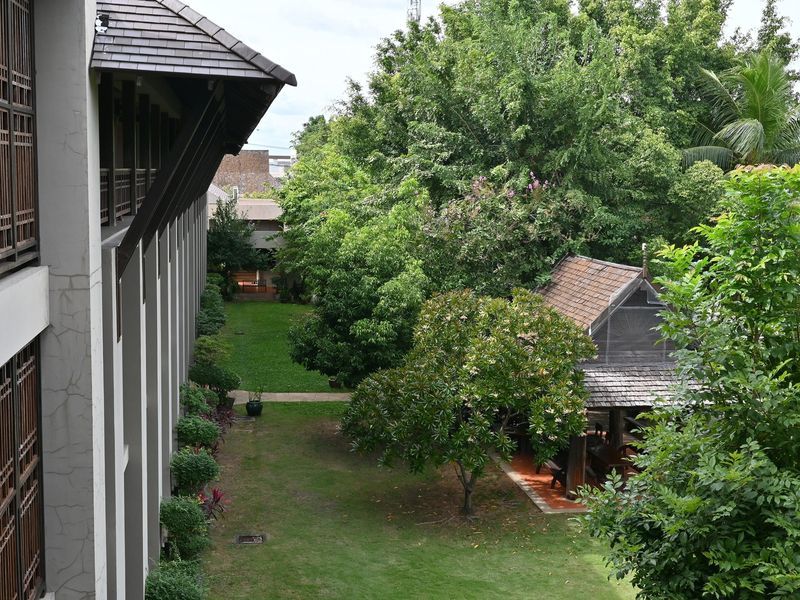
4. How many lawns, and how are they connected?
Front and back lawns linked by a path, a strip along the side of the house, an island around a pond — wire-free mowers handle these as zones and channels in the app. Check three numbers in the specs:
- Number of zones the app supports;
- Narrowest passage the mower can drive through (body width + margin, often 60–80 cm);
- Obstacle crossing height if it has to cross a kerb, a lawn edge or a step — AWD mowers manage 5–8 cm, most 2WD models 2–4 cm.
If zones are not connected at all, you will carry the mower across. Light mowers (under 15 kg) make that much easier.
5. Edges, paths and borders
No robot cuts perfectly to a wall; the blade disc sits inside the body. Look for cut-to-edge features (offset discs, edge trimmers such as Ecovacs TruEdge or Dreame EdgeMaster) if you hate strimming, and plan lawn edges flush with paths so the mower can drive over the edge. Expect to trim along walls and fences by hand a few times per season anyway.
6. Noise, wildlife and security
- Noise: most robots run at 55–65 dB(A) — quieter than a conversation. If neighbours are close, check our quietest robot mowers.
- Wildlife: avoid night mowing in hedgehog areas; AI vision helps, but no system is perfect.
- Theft protection: PIN lock, alarms and 4G + GPS tracking are worth paying for on front lawns. Several brands include 4G service for 1–3 years.
7. Budget and running costs
The price on the box is not the full cost. Budget also for blades (a few dollars per set, changed every 1–2 months in season), possibly a garage, an RTK mount or extension cable, a replacement battery after 3–5 years, and any 4G subscription after the free period. Set a budget, then pick the best mower that fits your answers to questions 1–6 — not the other way round. Our buyer's lists by price are a good start.
Your 10-minute checklist
+Good signs on a spec sheet
- Rated area clearly above your real lawn
- Slope rating 10+ points above your steepest spot
- Navigation suited to your tree cover
- Multi-zone maps and no-go areas in the app
- Regular firmware updates and spare parts available
−Red flags
- Rated area only just covers your lawn
- Slope given in degrees without percent (can hide a low rating)
- RTK-only mower for a heavily shaded garden
- No local service or parts in your country
- Mandatory paid subscription for basic mowing features
Bottom line
Choose the garden first, the mower second: real lawn size plus a buffer, steepest slope, sky view, zones and edges. Those five answers narrow 70+ models to a handful — then compare those side by side and pick on price, app and service.
Frequently asked questions
How do I measure my lawn for a robot mower?
Use the area measuring tool in Google Maps or Google Earth, outline only the grass and subtract beds and paths. Then add 30–50 % so the mower is not working at its limit.
Do I need an AWD robot mower?
Only if your lawn has slopes steeper than about 45 % (24°), rough ground or kerbs to climb. On flat and gently sloping lawns a 2WD mower is cheaper and lighter.
Is a boundary wire still worth it?
Yes for small, heavily shaded gardens or very tight budgets. For most gardens a wire-free RTK, LiDAR or vision mower is easier to install and change.
How long does a robot mower battery last?
Typically 3–5 seasons before capacity drops noticeably. Many models have replaceable batteries; check availability and price before you buy.
Next steps: compare your shortlist in our side-by-side comparison, read about navigation systems, and when autumn comes, follow our guide on how to winterise a robot mower.
We have been mowing lawns for 32 years — from a hand scythe to today’s RTK, LiDAR and vision robots. We compare, set up and troubleshoot robot mowers so you can pick the right one for your garden.